wanaku-ai/wanaku
The Wanaku MCP Router is a SSE-based MCP server that provides an extensible routing engine that allows integrating your enterprise systems with AI agents.
Add to Claude Desktop config.json
{
  "mcpServers": {
    "wanaku-ai-wanaku": {
      "command": "node",
      "args": [
        "~/.mcp/wanaku/index.js"
      ]
    }
  }
}
Get the source and run locally
git clone https://github.com/wanaku-ai/wanaku.git ~/.mcp/wanaku
cd ~/.mcp/wanaku
About this MCP server
Wanaku - A MCP Router that connects everything



The Wanaku MCP Router is a router for AI-enabled applications powered by the Model Context Protocol (MCP).
This protocol is an open protocol that standardizes how applications provide context to LLMs.
The project name comes from the origins of the word Guanaco, a camelid native to South America.
Key Features
- Unified Access - Centralized routing and resource management for AI agents
- MCP-to-MCP Bridge - Act as a gateway or proxy for other MCP servers
- Extensive Connectivity - Leverage 400+ Apache Camel components for integration
- Secure by Default - Built-in authentication and authorization via Keycloak (optional — can run without auth)
- Kubernetes-Native - First-class support for OpenShift and Kubernetes deployments
- Extensible Architecture - Easy to add custom tools and resource providers
- Multi-Namespace Support - Organize tools and resources across isolated namespaces
Quick Start
Getting started is a single command. Download the CLI from releases page, unpack, and then just run:
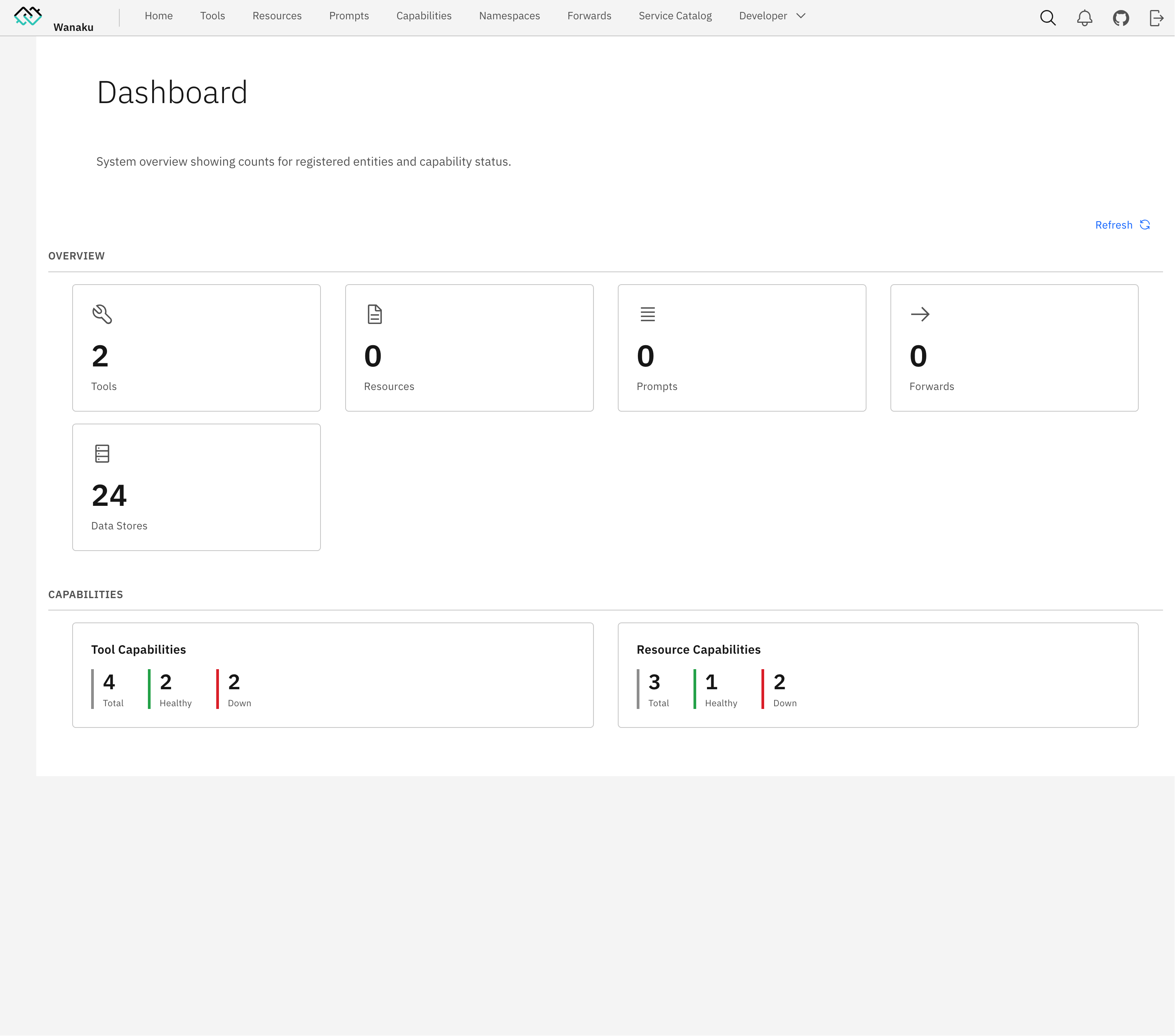
wanaku start localAccess http://localhost:8080 to enter the dashboard:
Learn Wanaku
The easiest way to learn Wanaku is by following the guided tutorial.
Basic Usage
The reference documentation, including the complete installation and configuration instructions, is available on the usage guide.
Documentation
The Wanaku Documentation website contains additional documentation, covering several of components that are part of the project - some of which are hosted in different repositories (i.e.: such as the Camel Integration Capability, the Java SDK, etc.).
Community
- GitHub Issues - Bug reports and feature requests
- Discussions - Ask questions and share ideas
- Examples - Example capabilities and integrations
Contributors working on the project may want to refer to the development version of the documentation including
- Pre-release Usage Guide - Pre-release usage guide
- Architecture - System architecture and components
- Building - Build and package the project
- Contributing - Contribution guidelines
- Security - Security policy and best practices
License
This project is licensed under the Apache 2.0 License - see the LICENSE file for details.
Similar MCP servers
MCP server that exercises all the features of the MCP protocol.
A high-level framework for building MCP servers in Python
Local-first system capturing screen/audio with timestamped indexing, SQL/embedding storage, semantic search, LLM-powered history analysis, and event-triggered actions - enables building context-aware AI agents through a NextJS plugin ecosystem.
Extract and convert YouTube video information.
Interacting with Obsidian via REST API
Connect AI agents to 600+ integrations with a single interface - OAuth, scaling, and monitoring included